Case · music tools

Solderpunk

Interactive synth explorers that connect sound design, browser UI, Web MIDI hardware control, cited instrument research, and local agent Q&A.

Release candidate Creative tooling Public source

Problem

Synth research and sound design often sit in separate worlds: manuals, videos, hardware intuition, scattered references, and browser demos that do not feel like instruments. Solderpunk turns that material into explorable software for learning, tweaking, and playing.

What I Built

I built Solderpunk as interactive AI-assisted synth explorers with Web MIDI hardware control, cited instrument corpora, local QMD/agent Q&A, and no environment-variable dependency. I rewrote the README to frame it around supported instruments, quick start, live MIDI control, corpus search, architecture, and public-release needs.

Instrument UX Explorable browser surfaces for parameters, presets, synthesis concepts, and live feedback.
Hardware control Web MIDI turns the project from static explanation into a playable tool.
Research loop Cited corpora and local Q&A connect sound design decisions back to source material.

System Architecture

Solderpunk system diagram with synth explorer, Web MIDI, sound engine, instrument corpus, local Q&A, learning loop, creative product, and public release boundary.
Public-safe product diagram. It shows the creative tooling shape, including synth explorers, Web MIDI, cited research, and local Q&A.
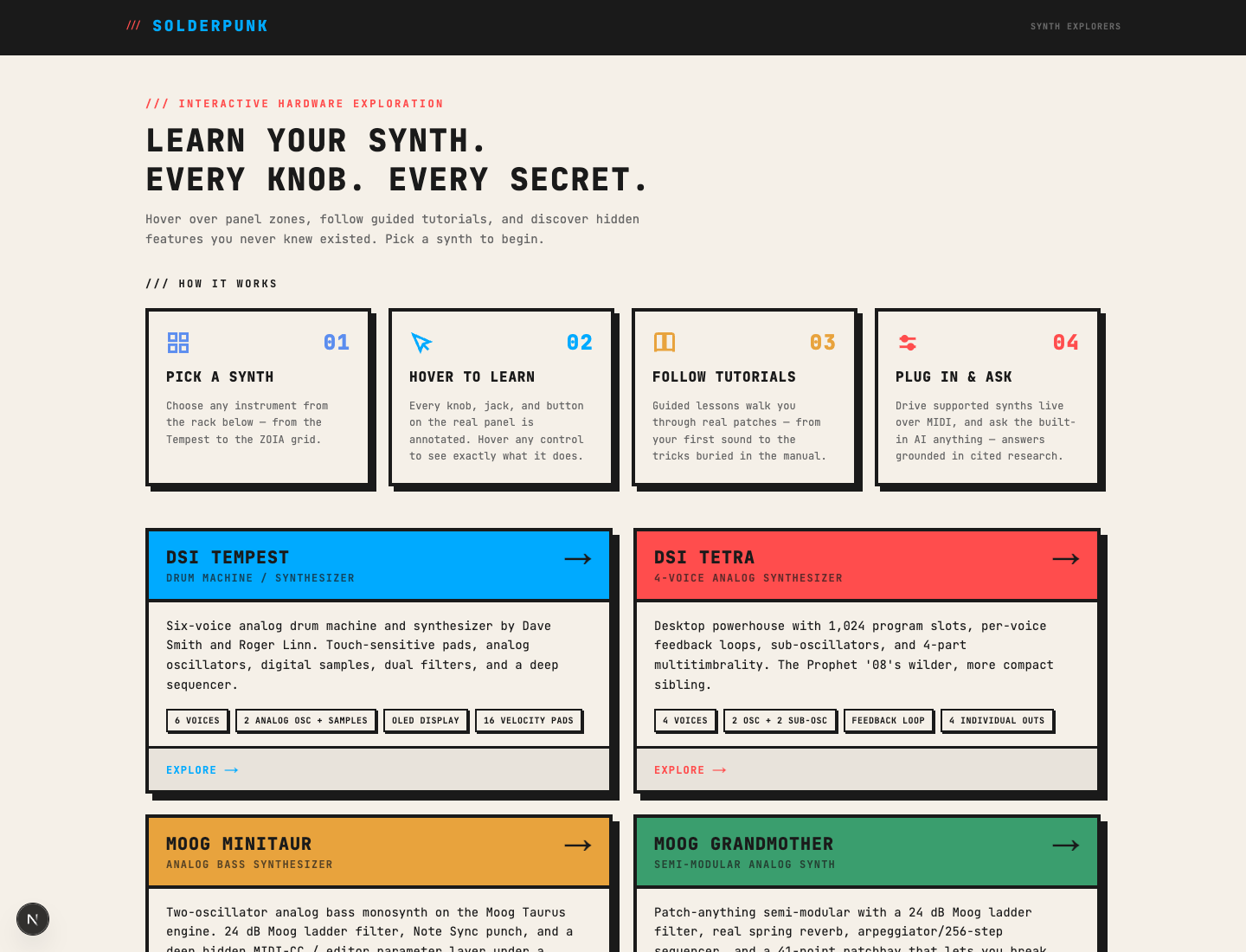
Solderpunk landing page showing synth explorer cards and a four-step interaction model.
Runtime screenshot from the local app. The landing page presents the product model: pick a synth, hover to learn, follow tutorials, and connect MIDI or ask the corpus.
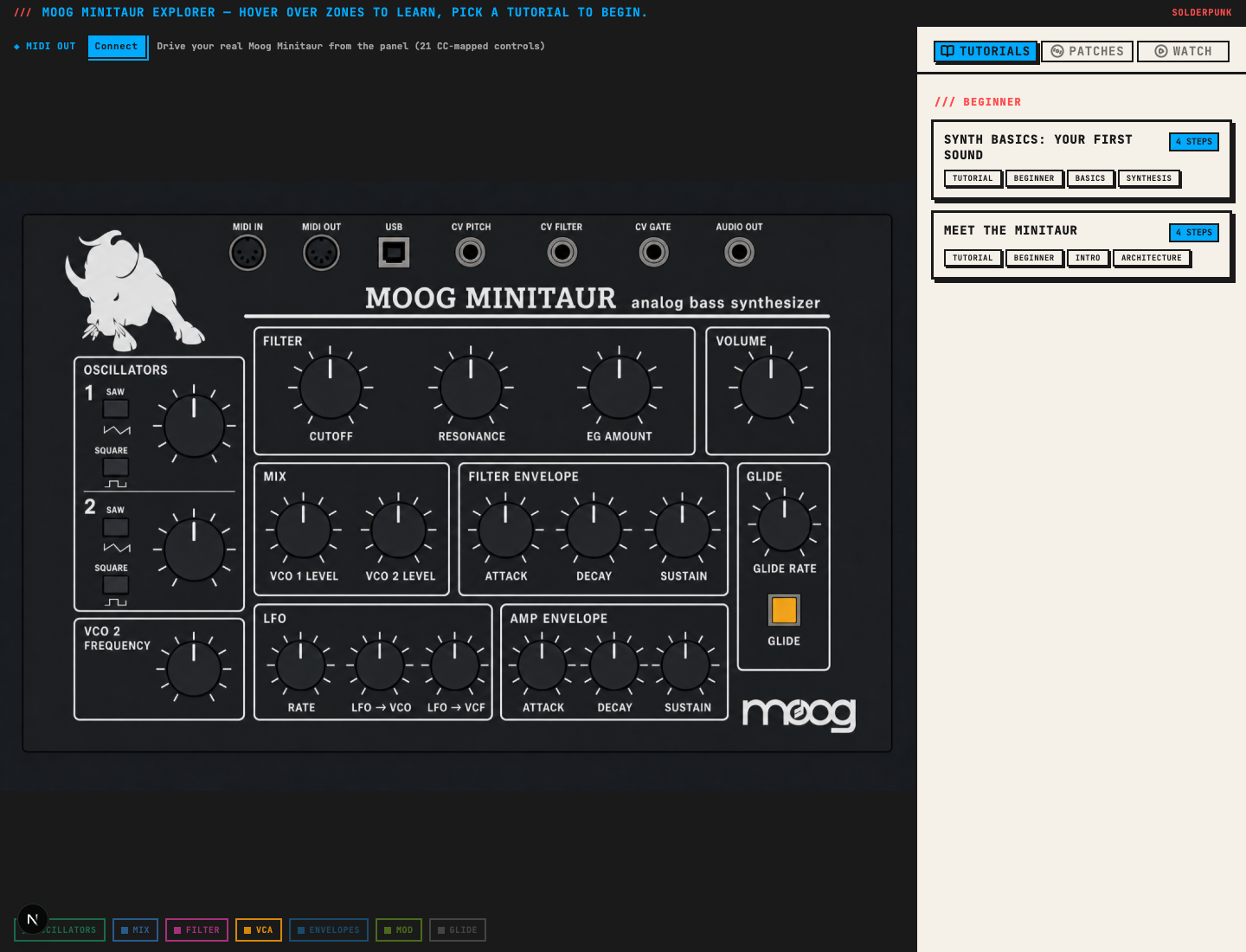
Solderpunk Moog Minitaur explorer showing panel render, MIDI bar, tutorial sidebar, and hotspot categories.
Minitaur explorer screenshot. It shows the real instrument panel, MIDI output affordance, tutorial sidebar, and hotspot categories.
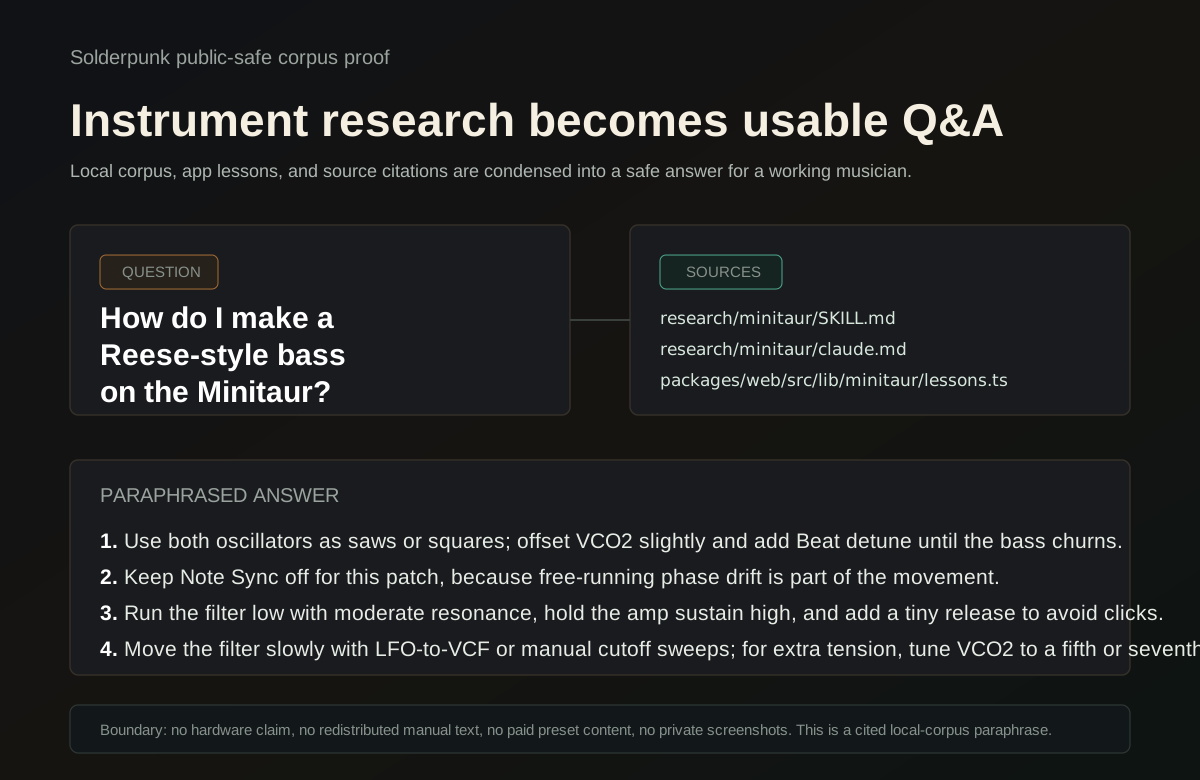
Public-safe Solderpunk corpus Q&A proof showing a Reese bass question, local source files, a paraphrased answer, and publication boundaries.
Corpus Q&A proof. The example is paraphrased from the local Minitaur research and app lesson files, then bounded so it can be shared without manuals, paid preset data, private screenshots, or hardware claims.

Technical Decisions

  • Make synthesis concepts interactive instead of burying them in prose.
  • Use Web MIDI so hardware control and UI exploration stay connected.
  • Keep cited instrument research close to the interface through corpus search and local Q&A.
  • Keep it legible and tasteful enough to publish as-is — the source is public.

What This Proves

Solderpunk shows creative tooling with real technical product taste: browser UI, musical domain judgment, hardware integration, local knowledge workflows, and a project shape that engineers can inspect without needing private business context.